Loading

Official Match Ball Partner
SELECTSPORT
Live
Every Champions League match is played with a printed SELECT ball. Here is who they are, and why that matters more than a logo on a sideline board.
The same ball, every matchHand-stitched since 1947The 32-panel ballEvery region, every fixtureFree to play, always
Our Core Sponsor
A League Cannot Run Without Balls
The High School Champions League is free to enter. No club fees, no pay-to-play gate, no parent invoice. That only works because the costs of running it are carried by people who believe in it — and the most basic cost of all is the ball.
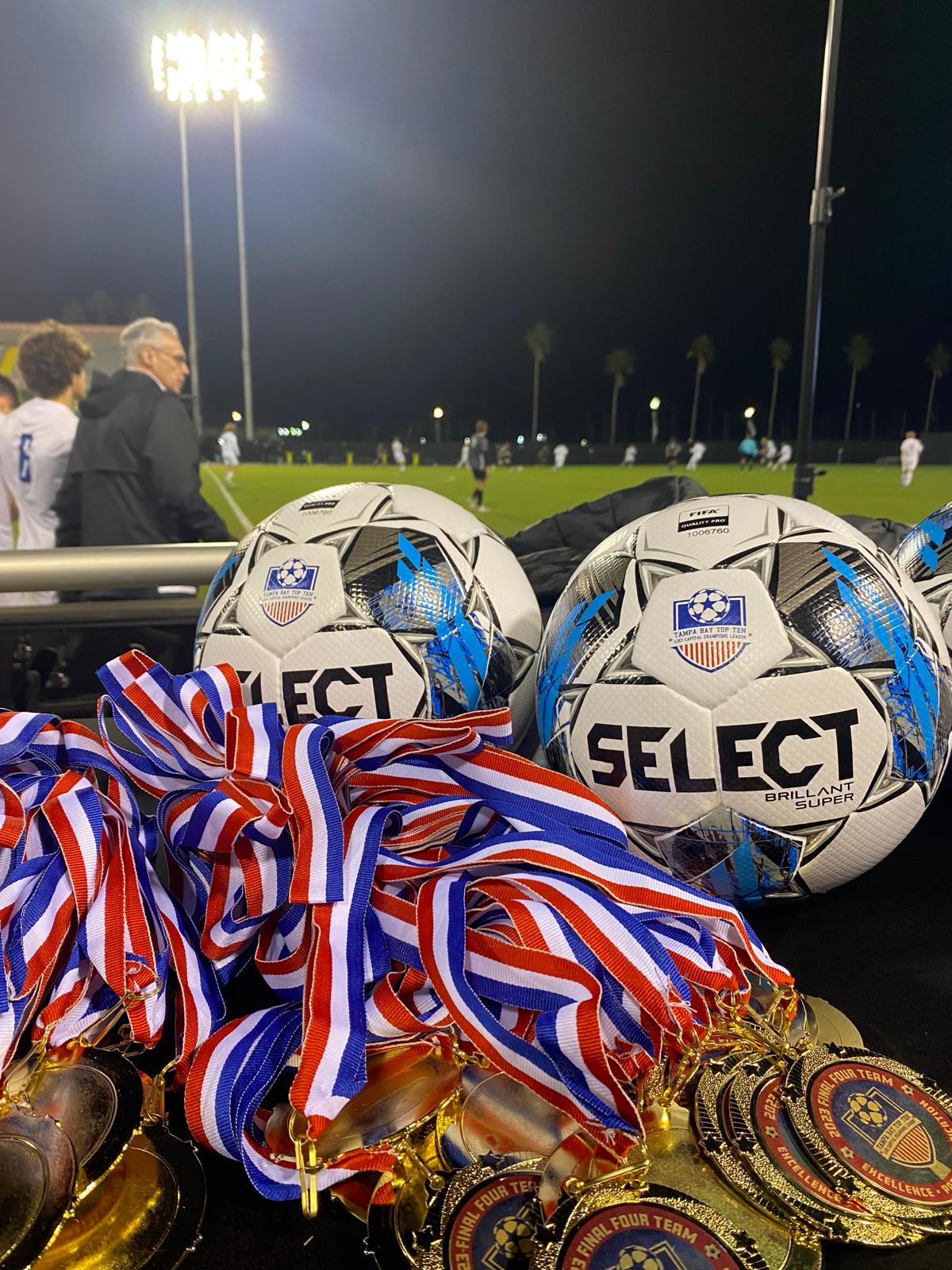
SELECT provides printed Champions League match balls to every game we play, across every region. Same ball in a group-stage fixture as in a final. It is the least glamorous form of sponsorship there is, and the one the league would not survive without.
1947
Founded in Denmark
4M+
Balls made each year
50+
Countries supplied
32
Panels, their invention
The Select Virtuoso Award
Not An MVP. A Virtuoso.
Every Champions League Final ends with one more award. Tim McEvoy of SELECT created the Select Virtuoso Award for this league: after years at Adidas, he wanted a unique award for a unique endeavor, and set aside the old MVP award concept to make one.
Where Tim is at the Final, he chooses the player and presents the award himself. In the other regions, people at the venue choose their player, and Tim ships the award to them.
“Virtuoso means a person who has shown exceptional skills, expertise or talent at some endeavor… it's the highest order of lifetime achievement.”
He named it for what he calls “the extraordinary talent from a magnificent endeavor which is High School Soccer in America.”

Since 1947
Seventy-Five Years Of Balls
- 1947
A goalkeeper starts a ball company
Eigil Nielsen — Denmark's national team goalkeeper, and a bronze medallist at the 1948 London Olympics — founds SELECT.
- 1951
The ball without a lace
SELECT launches a ball with a built-in valve and no external stitching, so it holds its shape and there is nothing on the surface to head into. The Danish FA signs them to supply the national team.
- 1962
The 32-panel ball
SELECT introduces the 32-panel construction — the geometry behind every round ball you have ever kicked, and the one they call their greatest contribution to the game.
- 1974
Off the cowhide
SELECT drops leather for the first hand-sewn synthetic ball, a material that goes on to become the standard.
- Today
Four million balls a year
SELECT supplies match balls to leagues including the German Bundesliga and exports to more than 50 countries — and, in the United States, to every High School Champions League fixture.
Milestones as told by SELECT · their history page
How They Build Them
They invented the shape
SELECT introduced the 32-panel ball in 1962 — the construction that makes a ball actually round, and the one nearly every ball since has copied.
Tested past the standard
Stitching, sphericity, circumference, weight and air retention are all checked before a ball ships. SELECT says its premium match balls are held to tolerances tighter than FIFA's.
Still hand-stitched
Around 40% of SELECT's four million balls a year are sewn by hand in Sialkot, Pakistan, then inspected again in Denmark.
Who Makes The Ball
The People Behind The Stitching
The balls our players kick are largely sewn by hand in Sialkot, Pakistan, by tailors at Anwar Khawaja Industries. SELECT runs a joint programme there — SAHEP — that it says provides free medical care and medicine to those tailors and their families, in a country with no social safety net to fall back on when someone gets seriously ill.
The same programme pays families to keep their children in school, and teaches the ones who cannot attend. SELECT says staff keep records of every tailor and their children and visit the families regularly, so the support actually lands. The company states plainly that it will not use child labour.
We are repeating SELECT's own account here rather than auditing it ourselves. We think it is worth knowing who made the ball before you buy one.
Source · SELECT's responsibility page
Back the people backing us
Play The Same Ball
Balls, keeper gloves, training kit — the same range that turns up at our fixtures. Buying from SELECT is the most direct way to support a company that puts a ball in front of every player in this league.Takes you to us.select-sport.com
Shop SELECT